
A moment of honesty: nobody is sitting around hoping someone invites them to another webinar.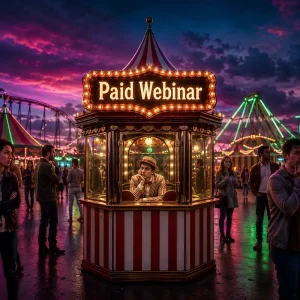
They are busy. They are distracted by life. They’ve got Netflix to watch.
They have inboxes that look like crime scenes and to-do lists long enough to qualify as historical documents.
So, if you want someone to pay for your webinar, you cannot simply announce it and hope they leap joyfully toward the buy button with credit card in hand.
They need a reason to BUY. A REAL one.
They need to understand why this matters, why it matters now, and why your paid training is worth their time, attention, and money.
And there’s a simple funnel that does just that!
It takes someone from mild interest => to clear understanding => to confident action (and purchase).
Not with hype.
Not with pressure.
Not with a 47-step funnel that looks like it was built by a caffeinated octopus.
A funnel with a clear, obvious path.
A paid webinar does not sell because the topic is good. It sells because the value is jumping off of the page.
And making the value scream is the job of your funnel.
A Paid Webinar Is Not Just an Event
Here is where many presenters get stuck.
They think they are selling a webinar / a training.
They are not.
They are selling a result.
They are selling movement from one place to another.
From confused to clear. From stuck to started.
From scattered to structured.
From guessing to deciding.
From good intentions to an actual plan.
That matters because people do not pay for information anymore. Information is everywhere. It is piled up online like laundry after vacation.
People pay for organized information that helps them get a result.
That is why last week’s article, How to Outline a Live Training People Will Actually Pay For, focused on building your training around a specific outcome. People do not pay for a lecture. They pay for a bridge.
This week, we are talking about the road that gets them to that bridge.
Because even the best training needs a path to purchase.
If your webinar is the transformation, your funnel is the system that sells the transformation.
Why Simple Beats Complicated
Complexity feels impressive to the creator. It rarely feels impressive to the buyer.To the buyer, complexity feels like work.
And your buyer already has enough work.
They have clients, emails, team members, deadlines, bills, family responsibilities, and at least one browser tab they opened three days ago and are now emotionally committed to keeping.
So when your funnel is confusing, you are not creating intrigue.
You are creating friction.
And ANY friction kills sales.
A simple funnel answers the essential questions in the right order:
- Is this for me?
- What problem does this solve?
- Why should I care right now?
- What will I get from attending?
- Why should I trust you?
- How do I buy?
- What happens after I buy?
That is not manipulation.
That is leadership.
A good funnel helps qualified people make a confident decision.
Your Funnel Is a Positioning Tool
A funnel is not just a sales mechanism.
It is a positioning mechanism.
It frames the problem and defines the stakes.
It separates your approach from every other free video, half-finished course, dusty PDF, and someday idea competing for your buyer’s attention.
That is strategy.
Strategy is choosing what matters.
For a paid webinar, that means your funnel must make a clear choice:
- One audience.
- One problem.
- One result.
- One choice.
That sounds simple, but it is where most people quietly start sweating.
Because choosing one thing means not choosing everything.
Good.
That is the point.
Your paid webinar becomes stronger when it is not trying to be a buffet for every possible buyer.
It becomes stronger when the right person reads your page and thinks:
Finally. Someone understands exactly what I need.
That reaction is not an accident.
It is the result of clear, strategic copy.
The Four-Part Funnel That Sells Tickets
You do not need a giant machine to sell tickets to a paid webinar.
You need four parts that work together:
- Traffic copy
- Sales page copy
- Checkout copy
- Follow-up copy
Traffic Copy
Gets the right people curious enough to click through to the event sales page.
Sales Page Copy
Turns interest into desire by explaining the event, the outcome, the value, and the reason to buy a ticket now.
Checkout Copy
Reassures buyers at the point of purchase and removes last-second hesitation before they complete the order.
Follow-Up Copy
A) (Non-Buyers) Reminds, persuades, and re-engages people who showed interest but have not bought yet.
- B) (Buyers) Acts as the retention and maximization loop, designed to welcome ticket holders and prevent buyer’s remorse.
That is the simple funnel.
Each piece has a job.
When each piece does its job, the buyer keeps moving through the process.
When one piece fails, the buyer hesitates.
And hesitation is expensive.
Sell the Outcome, Not the Agenda
A wise person once said, “Sell the destination, not the travel.”
Spend 90% of your time talking about how much fun they’re going to have on vacation, not describing the plane, boat, train, or car that’s going to get them there.
Many webinar sales pages make the same mistake.
They sell the schedule.
Module one.
Module two.
Module three.
That’s fine, but it is not enough.
The buyer does not wake up craving modules.
The buyer wants progress.
So instead of leading with the agenda, lead with the outcome.
Ask yourself:
- What will they create?
- What will they fix?
- What will they decide?
- What will they leave with?
A coach may want a clearer offer.
A speaker may want a stronger signature training.
A funnel marketer may want a cleaner conversion path.
A business professional may want a repeatable system for selling expertise.
A leadership professional may want a practical way to turn leadership content into paid training that attracts the right audience.
Different audiences.
Same principle.
People pay for a result they recognize as valuable.
Your funnel copy must connect the dots between their current frustration and your promised outcome.
The clearer the connection, the easier the buying decision becomes.
Simple Funnels Create Trust
Trust does not come only from testimonials and credentials.
Trust also comes from clarity.
When your funnel is clear, people assume your training will be clear.
When your sales page is structured, people assume your webinar will be structured.
When your follow-up emails are useful, people assume your teaching will be useful.
That is why the funnel is part of the product experience.
Before they ever attend, your marketing is already teaching them what it feels like to work with you.
Messy funnel = messy perception.
Clear funnel = clear perception.
For a paid webinar, this matters because the buyer is making a value judgment before they have received the value.
Final Thought
If you want to sell tickets to a paid webinar, do not rely on enthusiasm.
Do not rely on the fact that your training is good.
Good is not enough.
People buy the result they believe they’ll get from your paid training!
That is what a simple funnel does.
And when the funnel is clear, the sale gets easier.
Not because you pushed harder.
Because you made the value obvious.
If you want help creating the sales pages, webinar emails, social posts, follow-up messages, offer copy, and promotional content that make your paid trainings easier to sell, check out CopyandContent.AI.
It helps you turn your ideas into clear, persuasive marketing faster, without staring at a blank screen like it has personally betrayed you.
Did You Miss The Latest Posts?
- Your Funnel Doesn’t Need More Promises. It Needs Receipts (aka testimonials) [Podcast 316]
- The Launch Checklist: What You Actually Need Done Before Pressing Go
- Why Most Entrepreneurs Make Product Launches Way Too Complicated
- A Great One-Time Offer Does Not Sell More. It Removes the Next Problem. [Podcast 315]
- Your Funnel Doesn’t Need More Promises. It Needs Receipts.
Facebook • Instagram • X • LinkedIn • TikTok • YouTube • LinkTree

Leave a Reply