

 The most profitable square inch in your sales funnel may be the little checkbox sitting right above the Buy button.
And most people waste it.
They treat the order bump like a checkout yard sale.
“You bought my course. Want a mug? A random ebook? My cousin’s meal plan? How about a slightly haunted printer?”
That is not an order bump. That is clutter with a price tag.
A great order bump does something very different. It makes the buyer look at it and think:
“Well, of course I need that too.”
No committee meeting. No spreadsheet. No call to their accountant.
Just an easy, logical yes.
There is a simple test that tells you whether your bump deserves that yes. It also exposes the mistake that quietly weakens a lot of otherwise solid offers. We will get to both in a minute.
First, let me tell you about a picnic table.
He Wasn’t Really Selling Picnic Tables
A friend of mine sold handmade picnic tables for years.
His customers were not really buying wood, bolts, and bench seats. They were buying Saturday afternoon. Burgers on the grill. Kids in the yard. Cold drinks. Time together.
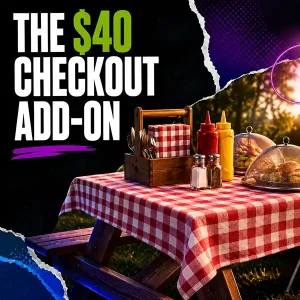
So at checkout, he offered an “instant picnic” package. It included:
- A red-and-white checkered tablecloth
- Clips to hold the cloth on the table
- Ketchup and mustard dispensers
- A caddy for silverware and napkins
- Food covers to keep the flies away
Nothing was revolutionary. Together, the items removed the annoyances standing between “new picnic table” and “we can use this tonight.”
The bundle cost him about $10. He sold it for $50. Roughly 80% of his customers added it to their order.
That raised his average order value by about $40 and added roughly $32 in expected gross profit per table order before payment fees and fulfillment.
He did not sell more stuff. He sold the easy, stress-free way to enjoy the first great afternoon at the new picnic table.
The Best Order Bump Is a Result Accelerator
Most marketers ask the wrong question at checkout:
What else can I sell them?
Ask this instead:
What will help them get the result they just paid for faster, better, or easier?
A great bump usually does one of four things:
- Improves the result. Templates can help a course buyer implement faster. A workbook can help a workshop attendee leave with something finished.
- Creates an easy button. A checklist, calculator, script, or swipe file reduces effort and uncertainty.
- Adds a natural companion. Someone buys the printed book, then adds the audiobook. The connection makes sense instantly.
- Prepares them for the next problem. Someone generates leads, then needs follow-up. Someone writes a book, then needs a launch plan.
Information tells people what to do. An easy button helps them actually do it.
The best order bumps solve the friction created by saying yes.
Use the B.U.M.P. Test
Before you add anything to checkout, run it through this four-part test.
B: Builds on What They Already Bought
The connection should be obvious without a paragraph of explanation.
Picnic table plus instant picnic kit. Book plus audiobook. Workshop plus workbook.
If you need a conspiracy board and three pieces of red string to explain the relationship, choose a different bump.
U: Unlocks Speed, Ease, or a Better Result
Your bump should remove work, delay, confusion, or risk.
It does not need to transform the buyer’s entire life. It needs to make the next part of the journey smoother.
M: Makes Sense in Five Seconds
Checkout is not the place for a new education campaign.
The buyer should understand what it is, why it matters, and what it costs almost instantly.
If your bump needs a video sales letter, a stack slide, and a FAQ, congratulations. You may have built another offer. It just does not belong in the checkbox.
P: Protects the Value of the Main Offer
The original purchase must still feel complete.
Use what I call the Penalty Test:
If the buyer says no to the bump, will they still feel fully served by the main product?
If the answer is no, fix the main offer.
That test protects trust. And trust is worth more than the quick bump revenue you can squeeze out of a disappointed customer.
Build Your Bump in 30 Minutes
You do not need a three-day retreat and a wall covered in sticky notes.
Start here:
- Write the main result in one sentence. What did the customer really buy?
- List the friction around that result. What slows them down before, during, or immediately after they use the main offer?
- Choose one small solution. Pick the item that removes the most obvious friction with the least explanation.
- Run the B.U.M.P. Test. Does it build, unlock, make sense fast, and protect the main offer?
- Write one checkbox sentence. Name the item, result, friction removed, and price.
- Test the economics. Track take rate, average order value lift, contribution lift, and customer impact.
Do not chase clever.
Chase obvious.
Relevance beats novelty at checkout.
The Question That Finds the Money
The next time you look at your funnel, do not ask:
What else can I put in the cart?
Ask:
What does this buyer need to make their original yes feel even smarter?
That question gave a picnic-table seller a $32 lift in average order value.
It can help a coach turn a course into implementation. It can help a speaker turn a workshop into action. It can help a consultant shorten the distance between advice and results.
And it can do all of that without making your checkout feel like a trap.
If you want help finding that missing piece, use the Order Bump tools inside CopyandContent.AI. Start with your main offer and the result it promises. The platform can help you identify logical add-ons, shape the value, and draft clear checkbox copy.
For example, if you sell a course, it can help you explore a workbook, launch checklist, swipe file, or implementation kit, then position the strongest option around the specific friction it removes.
Because the best bump is not “one more thing.”
It is the thing that makes the first thing easier to use.
Did You Miss The Latest Posts?
- Why Most Entrepreneurs Make Product Launches Way Too Complicated
- A Great One-Time Offer Does Not Sell More. It Removes the Next Problem. [Podcast 315]
- Your Funnel Doesn’t Need More Promises. It Needs Receipts.
- The Tiny Checkbox That INSTANTLY Makes Your Funnel More Profitable – The Order Bump! [Podcast 314]
- The Video Sales Letter Compresses the Buying Decision with Customers [Podcast 313]
Facebook • Instagram • X • LinkedIn • Pinterest • Podcast • TikTok • YouTube • LinkTree

Leave a Reply