
 You have something worth selling (and buying).
So why does launching it suddenly require two weeks, six planning meetings, and a spreadsheet that needs its own onboarding video?
Somewhere between “I can help people with this” and “Let’s open the cart,” a simple offer became a HUGE production.
You don’t need a bigger launch.
You need a clearer sequence.
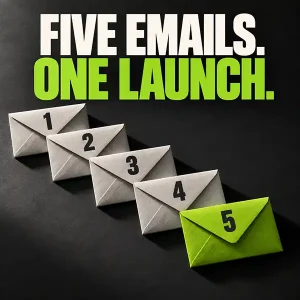
Surprisingly, five emails can do the job. But there’s a catch: send five versions of “buy my stuff” and you haven’t built a launch. You’ve built an annoying test.
The Magic 5 works because each message moves the buyer’s decision forward. And the last email comes with a trap I fell into early on, one that can limit what you sell long after launch week ends.
Last week, we looked at getting your launch pieces ready before pressing GO. Now let’s put the email portion to work with a five-day plan you can actually finish.
Give each email a different question to answer
Picture a coach with a useful workshop ready to sell. The slides are done. The checkout works. People on her list have asked about the problem it solves.
Then she opens a blank email and thinks, “How do I explain EVERYTHING?”
She lists every lesson, adds her backstory, mentions the bonus, and wedges the deadline somewhere below paragraph seventeen.
The reader sees homework… NOT a result and solution to their problem.
Here’s a better way to think about the sequence: five questions your buyer needs answered.
Why should I care?
What can I get out of it?
Why should I believe you?
Why act now?
When does this end?
Those questions move people from awareness to desire, then toward a decision.
This works best when you have a relevant audience, a clear offer, and a working way to buy. Five emails won’t turn strangers into loyal fans overnight or fix an offer nobody wants.
But they can give interested people the information and nudge they need.
Day 1: Heads up, something useful is coming
Your first email creates anticipation by naming a result your reader REALLY wants.
Let’s use an example offer: a live workshop helping managers run shorter, more useful meetings.
You might open with:
“If your team needs a meeting to recover from the last meeting, watch your inbox tomorrow.”
Then explain what’s coming: a practical way to build an agenda that ends with clear decisions and responsibilities.
Don’t make people solve a mystery to figure out whether this matters to them. “Something HUGE is coming” could mean a useful workshop or a new office refrigerator.
Be specific about the benefit. Save the full offer for tomorrow.
Your next step is simple: “Tomorrow, I’ll send you the details.”
Day 2: Here’s the offer
Now announce that it’s available.
Tell readers who it’s for, what they’ll get, what it helps them accomplish, and where to buy.
For our workshop, the message might say:
“Registration is open. Bring one recurring meeting you and your team dread like chickenpox. We’ll use it to build an agenda with a clear purpose, decision points, and owners for the next steps.”
That gives the buyer something to picture beyond “90 minutes of valuable training.”
If the launch includes a bonus, explain it here too. Don’t hide the offer’s best details until people have already decided against it.
Then link to the offer page with a direct invitation to register.
Clarity gives desire somewhere to go.
Day 3: Show them why they can believe it
By now, an interested reader may be thinking, “Sounds good. But will this work for someone like me?”
Answer with relevant proof.
Use a real customer story, your own documented experience, or a demonstration. Explain the starting problem, what changed, and what actually happened for the customer.
If you have customer results, include the context that makes them meaningful. A specific story from a manager facing a familiar problem can be more useful than a glowing quote that says “Amazing!”
Customer proof helps the reader recognize their problem in someone else’s progress.
Close by inviting them to see how the offer addresses that same problem.
Day 4: Give them a reason to act now
“Maybe later” is an reasonable excuse to forget your offer.
The reason to act now (or by a deadline) needs to be crystal clear and leave them with the fear of missing out.
Suppose the workshop includes an agenda review for people who register by Friday. You can explain why: you need time to review submissions before the session.
The message is:
“Register before Friday’s deadline and submit your agenda for review, so you can arrive with feedback for the meeting you actually need to fix.”
That bonus helps the buyer use the purchase. It has a purpose beyond making the offer look bigger.
Use a real incentive you can deliver: a relevant bonus, introductory price, limited capacity, or access to a scheduled event.
Today emphasizes why acting now is worthwhile. Tomorrow makes the ending feel like it has consequences.
Day 5: Tell them exactly what ends
The final email should make the decision easy to understand.
Restate the main benefit. Specify what disappears, the exact date and time, and the time zone. Give them the link.
For example:
“The agenda-review bonus ends today, Friday, at 5 p.m. Eastern. Register before then to include it with your workshop purchase.”
Keep the terms consistent with the earlier emails. If only the bonus ends, say that. Don’t imply the entire product disappears.
Here’s the mistake I made in one of my first launches: I said I would never sell the product again.
Be careful with that promise. You may want to offer the product later, and “never” doesn’t leave much room on the calendar.
Your deadline should close an offer without closing off your future.
When the deadline arrives, honor it. A timer that keeps restarting teaches people exactly how seriously to take the next one.
Write the five before you send the first
Choose one offer. Set the real deadline. Plan one email per day, Monday through Friday in this example. Write one sentence answering each buyer question, then expand those sentences into your five emails.
Make each message understandable on its own. Some people will miss Tuesday and open Thursday. Repeat the essential offer details, while giving each email a fresh reason to read.
Test the links and checkout. Move buyers into a welcome sequence so they aren’t still getting reminders to buy what they just bought.
Need help turning that outline into copy? Visit CopyandContent.AI and use its email-writing tools to draft messages around your audience and offer. For the workshop example, supply the manager’s problem, the promised deliverable, your real proof, and the bonus deadline. Then review each draft against its one job.
You can use the same flow for social posts, too. The channel changes. The buyer’s questions remain.
What could you launch if you only had to write the next five useful messages?
Did You Miss The Latest Posts?
- The Magic 5 Email Sequence: How to Launch Your Product in 5 Days
- Why Most Entrepreneurs Make Product Launches Way Too Complicated [Podcast 317]
- Your Funnel Doesn’t Need More Promises. It Needs Receipts (aka testimonials) [Podcast 316]
- The Launch Checklist: What You Actually Need Done Before Pressing Go
- Why Most Entrepreneurs Make Product Launches Way Too Complicated
Facebook • Instagram • X • LinkedIn • Pinterest • Podcast • TikTok • YouTube • LinkTree

Leave a Reply