


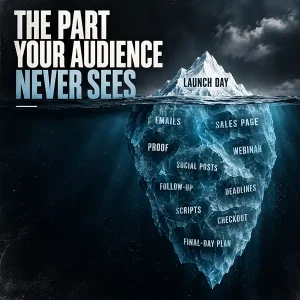
 Most product launches do not fail because the offer is bad.
They fail because somebody pressed GO while half the launch was still living in their head.
The emails were “almost done.”
The testimonial graphics were “coming.”
The webinar slides needed “one more pass.”
Nobody was quite sure what was happening Thursday.
And the final day plan?
“We’ll figure it out when we get there.”
That is not a launch plan.
That is a group project with no accountability.
Last week, we talked about why entrepreneurs make product launches way too hard – read it here.
Now comes the uncomfortable part.
You have to turn that plan into a calendar.
Because a launch is not a pile of content.
A launch is a timed sequence of decisions.
And there is one part of the launch that exposes sloppy planning faster than anything else.
It is not opening day.
It is the weird, quiet part in the middle of the launch where it feels like not much is happening.
We’ll get there.
Start At The End, Not The Beginning
Most people plan a launch by asking:
“What should we do first?”
Wrong question.
The first question is:
When does the offer close?
Pick the deadline.
Tuesday at midnight. Friday at 5 p.m. Whatever makes sense for the offer, your audience, and the reason you are giving people to act.
Then work backward.
If the cart closes Friday, what needs to happen Friday morning?
Thursday?
Wednesday?
When does the webinar happen?
When does the first email go out?
When does your audience first hear that something is coming?
I call this the Deadline Backward Method.
The deadline is the anchor. Everything else gets a date because the deadline has a date.
Without that anchor, your launch becomes a collection of “sometime this week” tasks.
And “sometime this week” is where launches go to die.
Build The Runway Before You Build The Airplane
Imagine opening your cart Monday morning.
You send the email.
You post on social.
You stare at the screen.
Then you realize you have no idea what Tuesday’s message is.
You stop asking:
“What does my buyer need to hear next?”
You start asking:
“What the heck can I post before lunch?”
Big problem.
Before launch day, map the major communication moments: videos, emails, social posts, lives, webinars, interviews, deadline reminders, and ALL follow-up.
Notice I said ALL follow-up.
A launch is not just the big event.
It is the conversation around the event.
People miss emails. They get interrupted during webinars. They save posts and forget them. They think, “I’ll come back to that,” then life happens and your brilliant offer falls straight out of their brain.
Your follow-up is not annoying when it is useful.
It’s customer service for distracted people.
Put Your Proof On The Table Before You Need It
Get your proof together before the launch.
Testimonials. Before-and-after examples. Case studies. Screenshots. Interviews. Customer stories. Your own results.
And don’t just collect praise.
Collect proof that answers objections.
If somebody thinks your system only works for experts, show a beginner.
If they think it takes too long, show a faster result.
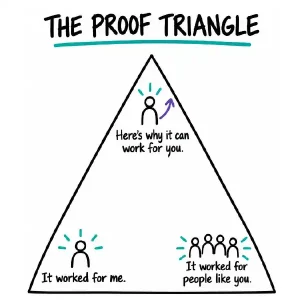 If they think, “Sure, it worked for you because you’re you,” show other people getting results too.
Here’s what I call the Proof Triangle:
It worked for me.
It worked for people like you.
Here’s why it can work for you.
That last part matters.
Proof shouldn’t just impress people.
It should help them see themselves getting the result.
Finish The Conversion Pieces Before The Applause Starts
Launches feel exciting at the beginning.
Everybody is watching. People register. Your team has energy.
Then the middle arrives.
Cue the crickets.
You start wondering whether anyone is paying attention.
This is where people panic and start changing things that did not need changing.
They rewrite the offer.
Add a bonus.
Invent another live.
Send a weird email with seventeen exclamation points.
Don’t let mid-launch emotion rewrite your strategy.
Before you open the cart, finish the core conversion pieces: the sales page, emails, social posts, webinar script, live outlines, deadline messages, proof assets, and follow-up sequence.
Then create a day-by-day checklist.
Not a “launch plan” buried in a 42-tab spreadsheet nobody opens.
A checklist.
Today, these three things happen.
This person owns them.
They are done by this time.
Boring?
Yep.
But “boring” makes money.
Plan Your Biggest Day Before It Arrives
For many launches, the last day is the biggest day.
Yet people prepare for it like they are surprised the deadline showed up.
Your final day needs three things turned all the way up:
- The reason to act now.
- The deadline.
- The payoff.
Not fake urgency.
A real reason.
Enrollment closes. The bonus expires. The live cohort starts. The price changes. The implementation window ends.
Whatever the reason is, make it clear and make it true.
Then reinforce what happens on the other side of the decision.
Don’t just remind people what they are buying.
Remind them what problem they are finally moving past.
And yes, use a countdown timer if the deadline is real.
A deadline without consequences is just a suggestion wearing a watch.
The GO Test
Before you press go, ask five questions:
- Is the close date set?
- Is every major content and communication piece scheduled?
- Is the proof organized and matched to likely objections?
- Are the sales and follow-up assets finished?
- Is the final-day plan already written?
If one of those gets a nervous little “sort of,” you’re not ready.
Build The Machine Before You Turn It On
A good launch should feel busy… It should not feel improvised.
The goal is not to remove every surprise. Something will always happen. A link breaks. A guest runs late. An email gets fewer clicks than expected.
That’s business.
The goal is to stop creating avoidable emergencies.
Set the deadline first.
Work backward.
Plan the content.
Gather the proof.
Finish the conversion pieces.
Build the checklist.
Prepare the final day.
Then press go.
And if creating all those launch assets is the part that makes you want to suddenly reorganize your garage instead, that’s exactly where CopyandContent.AI can help.
You can use it to turn your launch plan into sales emails, social posts, sales page copy, webinar messaging, follow-up content, and deadline reminders without starting from a blank screen every morning.
Because the best time to write your launch is not during your launch.
Build the machine first. Then turn it on.
Did You Miss The Latest Posts?
- The Launch Checklist: What You Actually Need Done Before Pressing Go
- Why Most Entrepreneurs Make Product Launches Way Too Complicated
- A Great One-Time Offer Does Not Sell More. It Removes the Next Problem. [Podcast 315]
- Your Funnel Doesn’t Need More Promises. It Needs Receipts.
- The Tiny Checkbox That INSTANTLY Makes Your Funnel More Profitable – The Order Bump! [Podcast 314]
Facebook • Instagram • X • LinkedIn • Pinterest • Podcast • TikTok • YouTube • LinkTree

Leave a Reply