


Why a Video Sales Letter Belongs in Your Funnel
 Picture this.
A prospect finds your offer during lunch. The headline gets their attention. The promise sounds useful. They are interested.
Then they notice the scroll bar.
It is the size of a grain of rice.
Your sales page is apparently longer than the terms and conditions for launching a satellite, and your prospect has twelve minutes before the next meeting.
… they leave.
Here is the part most marketers hate admitting: they didn’t reject your offer. They rejected the amount of work it took to understand it.
That is why you need a Video Sales Letter (VSL).
Not because video is magic. It is not. A boring sales pitch in a video does not become persuasive just because it’s wearing headphones.
You need a VSL because your prospects do not all make decisions the same way.
- Some want the whole case.
- Some want the short version.
- Some need to see the thing work before they believe a word you say.
And there is a simple way to serve all three without turning your funnel into a digital yard sale.
Your Prospect Is Not Lazy. Your Funnel Is Charging an “Attention Tax.”
A long-form sales letter can be powerful. It can stack proof, handle objections, explain the offer, and answer the quiet question hiding behind every click: Will this work for someone like me?
But not every buyer needs every argument.
Imagine you sell a leadership coaching program. One prospect has followed you for two years. She already trusts your ideas, knows her team has a communication problem, and has budget approval.
She may need ninety seconds, not twenty pages.
Another prospect is skeptical. He wants the curriculum, testimonials, guarantee, frequently asked questions, and perhaps your dental records.
Same offer. Different appetite for information.
When you force both people down the same path, you make one wait and leave the other unconvinced.
A VSL does not replace reading. It removes reading as the only path.
Video Can Compress the Buying Decision
Suppose you sell software that turns a rough webinar transcript into a clear sales campaign.
You could spend six paragraphs describing the dashboard, workflow, and finished output.
Or you could show this:
Rough transcript goes in.
Polished campaign comes out.
Twenty seconds. The mechanism is understood.
That is the first major advantage of a VSL: compression.
Video can demonstrate movement, sequence, tone, transformation, and ease at the same time. While written copy explains the recipe, video lets the prospect smell dinner.
This matters for software, courses, coaching frameworks, physical products, assessments, templates, memberships, and services with a visible before-and-after.
If seeing the process makes the value obvious, hiding that process in paragraphs is marketing with one hand tied behind your back.
Video “Shows” What Text Cannot
Now imagine two people saying, “I understand what you are dealing with.”
One is a line of text.
The other is a real person looking into the camera, slowing down, and speaking like they actually mean it.
Same words. Different weight.
A VSL carries facial expression, timing, confidence, warmth, and conviction. Prospects can hear the pause before an important point. They can see that you know the problem. They can decide whether they trust you.
If you don’t show AND tell… you won’t sell!
That does not mean you need dramatic music, a rented Lamborghini, or the vocal intensity of someone announcing the end of civilization.
It means you need clarity with a pulse.
The Two-Track Sales Page
Here is the mistake to avoid: treating video and written copy like rival candidates in an election.
They are not competitors. They are teammates.
Build a Two-Track Sales Page:
- The “watch” track: Put a short VSL near the top for people who want the fast, visual, emotional version.
- The “read” track: Place clear sales copy beneath it for people who prefer to scan, verify details, compare features, and revisit proof.
Most likely what will happen is The “hybrid” track where people watch first, then scroll/scan for the specific information they still need.
Some prospects will watch. Some will read. Your best prospects may do both.
The video earns attention. The copy satisfies scrutiny.
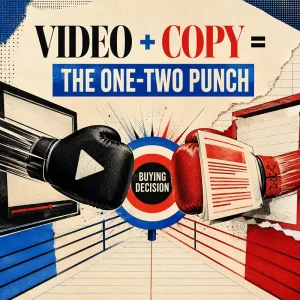
That is the one-two punch.
Use the W.A.T.C.H. Script
Do not wing your VSL.
Off-the-cuff is wonderful for jazz. It is expensive in a funnel.
Use this five-part script instead:
- W – Wake them up, 0 to 10 seconds. Name the problem or desired result in language the prospect already uses.
- A – Agitate the cost, 10 to 35 seconds. Show what delay, confusion, or the wrong approach is costing them.
- T – Teach or demonstrate, 35 to 65 seconds. Reveal the mechanism. Show the product, process, or key insight in action.
- C – Confirm with proof, 65 to 90 seconds. Use a result, testimonial, demonstration, or credible reason to believe.
- H – Hand off to the next step, 90 to 120 seconds. Tell them exactly what to do, then point them to the supporting copy below.
Keep it under 90-120 seconds when the job is to open the sale, demonstrate the idea, and direct the prospect to the next step.
Short does not mean rushed.
Every second needs a job. Every word of your script counts.
Write the script. Read it aloud. Remove anything that sounds like a brochure. Record it. Add captions. Then test the page with the video and copy working together.
Your Next Move
Look at your current sales page and ask three questions:
- What part of this offer would be understood faster if people could see it?
- What emotion or conviction is watered down in the written copy?
- What does a ready buyer need to hear in the next two minutes to take the next step?
Those answers are in your VSL.
Do not make prospects choose between reading a novel and leaving. Give them a faster path into the value, then give them the written proof to make a confident decision.
If a blank script is slowing you down, use CopyandContent.AI to turn your offer, audience, objections, proof, and demonstration into a timed VSL draft.
For example, enter the problem your leadership program solves, the framework you teach, one client result, and the next step you want viewers to take. Then shape the output with the W.A.T.C.H. structure and align the written sales page underneath it.
That’s how you stop asking one format to do two jobs.
Did You Miss The Latest Posts?
- Your Prospect Does Not Owe You 20 Pages
- DEBATE: Short form or Long form Sales Letter (The Argument Asks the Wrong Question…) [Podcast 312]
- Texting (SMS) or Email Follow Up Work Flow to the Customer [Podcast 311]
- The Next Sell Starts Before the First One Ends [Podcast 310]
- Are Long-Form Sales Letters Dead?
Facebook • Instagram • X • LinkedIn • Pinterest • Podcast • TikTok • YouTube • LinkTree

Leave a Reply